

How to Overcome Fear
Most of what we worry about never actually happens.
Think about that for a second.
How many nights have you spent overthinking something? Replaying conversations in your head. Imagining worst-case scenarios. Convincing yourself something terrible was going to happen… only to later realize it either never happened at all or wasn’t nearly as bad as you imagined?
I think this happens to almost everyone.
And honestly, fear has held me back many times in my life, too.
Fear of failing.
Fear of looking stupid.
Fear of making the wrong decision.
Fear that maybe I wasn’t ready, smart enough, capable enough, or good enough.
Looking back now, what’s interesting is that the majority of those fears never became reality. They existed mainly in my mind.
And over time, after missing opportunities and holding myself back far too many times, I finally started noticing something important:
Fear often grows larger in imagination than it ever becomes in real life.
The Strange Power Of Avoidance
There’s an old concept sometimes referred to as “the law of non-resistance.”
The basic idea is fascinating:
If you are willing to do the thing you are afraid to do, you often no longer have to.
Now, at first glance, that sounds strange. But the more I’ve experienced life, the more I’ve seen it happen.
There’s something incredibly powerful about facing things directly.
Not because fear magically disappears…
But because avoidance is often what gives fear its power in the first place.
Think about how fear works.
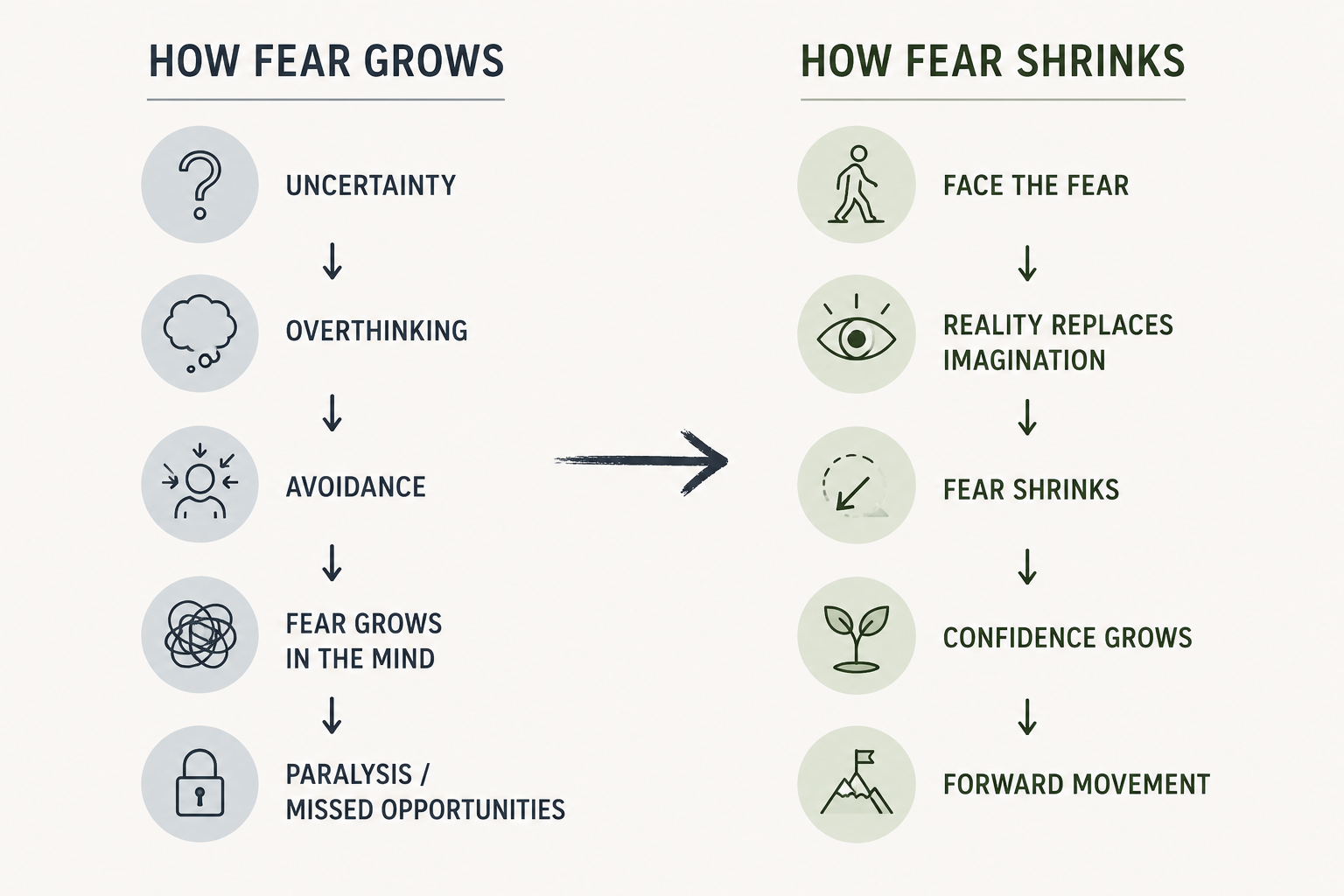
The longer we avoid something, the more time we spend thinking about it. The more we replay scenarios in our heads. The more we build it up emotionally.
Eventually, the imagined version of the situation becomes far scarier than reality itself.
And this is where many people get trapped.
Not by reality.
But by anticipation.
The Ladder Story
There’s an old story about a woman who was terrified of walking under ladders because she believed something bad would happen if she did.
One day, she went to the bank to place a valuable jewel into her safety deposit box. But as she approached the vault, she realized a ladder blocked the entrance. The only way to reach her box was to walk underneath it.
She panicked.
She stood there trying to convince herself that nothing bad would happen. She wanted to do it… But fear stopped her.
Finally, unable to bring herself to walk under the ladder, she turned around and left the bank.
But as she walked away, something bothered her.
Was she really going to spend her entire life controlled by this fear?
Suddenly, courage came over her.
She turned around, walked boldly back into the bank, and decided she was finally going to face the thing she had feared for years.
But when she got there…
The ladder had already been moved.
It was gone.
Now, whether the story is symbolic or literal isn’t really the point.
The lesson is what matters.
She finally became willing to face the fear… and by the time she did, there was nothing left to fear.
And honestly, I think life works this way more often than we realize.
Fear Usually Lives In The Mind First
One of the biggest realizations I’ve had in life is this:
Fear often has far more power in our minds than it does in reality.
That doesn’t mean fear isn’t real. Some situations genuinely are dangerous or risky. But many of the fears that control our lives are not physical threats.
They’re imagined outcomes.
Embarrassment.
Failure.
Judgment.
Rejection.
Uncertainty.
And because these fears exist in the mind, they tend to grow through overthinking and avoidance.
The more you avoid something, the more mysterious and powerful it becomes.
But when you finally face it in reality, something surprising often happens:
It shrinks.
The conversation wasn’t as bad as you imagined.
The opportunity wasn’t as terrifying as it seemed.
The failure wasn’t the end of the world.
The uncertainty became manageable once you stepped into it.
This is one reason learning how to stop overthinking is so important. Overthinking feeds imagined fear while action exposes reality.
Courage Is Not Fearlessness
People sometimes think courage means not feeling afraid.
That’s not true.
Courage is moving forward despite fear.
In fact, some of the most courageous people in the world still feel uncertainty, doubt, nervousness, and fear.
The difference is simply this:
They don’t allow fear to make their decisions for them.
And that realization changed my life.
Several years ago, I started putting this idea to the test. Anytime I noticed myself fearing something, I intentionally leaned toward it instead of avoiding it.
And over and over again, I discovered the same thing:
Most of the fears existed far more in my mind than in reality.
And when I finally did the thing I feared, it was almost never as bad as I had imagined.
Why Facing Fear Builds Confidence
This is important to understand:
Confidence does not usually come before action.
It comes after action.
Many people wait to feel ready before moving forward.
But readiness often comes from experience, not thinking.
Every time you face fear and survive it, your mind gathers evidence that you are capable.
That’s how confidence grows.
Not from avoiding discomfort…
But from proving to yourself that you can handle it.
This is also why facing fear is one of the fastest ways to build mental resilience. You begin to teach yourself that uncertainty is survivable and that discomfort does not automatically mean danger.
Now, I’ve also written about how to get motivated, why waiting to feel completely ready often keeps people stuck, and how action itself creates clarity and confidence.
So, What Should You Do?
Well, it’s pretty simple.
If there’s something you’ve been avoiding…
A conversation.
A decision.
An opportunity.
A change you know you need to make.
Maybe this is your reminder.
Take the step.
Not because you’re fearless.
But because the fear itself may be far bigger in your imagination than it is in reality.
And maybe, just maybe…
The moment you finally face it…
It will lose the very power it once had over you.
I still feel fear sometimes.
I still overthink things occasionally.
I still feel uncertainty from time to time.
But I no longer let fear control my direction.
Because experience has taught me something incredibly valuable:
Most of the things we fear never actually happen.
And the ones that do…
Are almost never as impossible as we imagined.
So here’s to doing things despite fear.
And here’s to discovering that courage often begins the moment you stop running.
Love,

Take your first step toward a life that actually feels yours.
Download my free book, Cracking the Millionaire’s Code, where I share how I climbed out of rock bottom and built a life of financial freedom—one where I could finally pursue my purpose and achieve my goals.
Inside, you’ll learn the first step I took that changed everything, and a simple yet powerful formula I developed to help you take that first step.