

One Page Plan: How to Turn Your Ideas Into Real Results
If I had a dollar for every amazing and brilliant idea I’ve had… I’d probably be a multi-millionaire.
And if I had actually taken action on even just a few of them… I’d probably be even better off.
So what happened?
Why is it that we can have great ideas, feel excited about them, even believe they could work… and still never do anything with them?
The answer isn’t a lack of ideas.
And it’s not a lack of ability either.
It’s something much simpler than that… and once you see it, it changes how you approach everything. In fact, I break this down further in my article on why most people don’t reach their potential, and you’ll see it’s often not what people expect.
Because the truth is, most ideas don’t fail because they’re bad ideas.
They fail because they never leave your head.
The Missing Piece Between Ideas and Results
At some point, almost everyone has had an idea that felt right. Something that solved a problem, something that could work, something that felt worth pursuing. You think about it, maybe even research it, maybe even picture what it could become.
And then… life happens.
You get busy. You get distracted. Or you simply don’t know what to do next.
So the idea stays where it started… in your mind.
And over time, it fades into that quiet place where so many good ideas end up, piling up and slowly being forgotten.
The gap between an idea and a result is not talent.
Its structure.
Because between the idea and the outcome, there are steps, decisions, and actions that need to happen, things that create direction and give real fuel to what you do next.
That structure is called a plan.
The Truth About Planning
Now here’s where most people get it wrong.
They think planning has to be complex. Detailed. Perfect.
But that kind of thinking is exactly what stops people from starting.
The reality is much simpler.
A plan doesn’t need to be complicated.
It just needs to be clear enough to get you moving.
Because no plan will ever have everything figured out in advance. Clarity doesn’t come from sitting and thinking about every possible outcome; it comes from action. From putting your idea into the real world and seeing how things actually respond.
And because of that, a plan isn’t something fixed.
It’s something that evolves.
As you take action, you learn. As you learn, you adjust. And over time, your plan becomes more refined, not because you thought it through perfectly at the start, but because you were willing to begin.
What Is a One-Page Plan?
This is where the idea of a one-page plan comes in.
A one-page plan is simply a way to take everything in your head and put it into one clear, visible place. Something you can look at in a matter of seconds and immediately understand what you’re doing and where you’re going.
It’s not meant to be perfect.
It’s meant to be useful.
Think of it like a roadmap. Not every turn is mapped out, but you know your direction, you know your next move, and you know how to keep going.
That’s what makes simple business planning so effective. It removes the noise and focuses on what actually matters.
Is One Page Really Enough?
This is usually the point where people hesitate.
“Is one page really enough?”
And the answer might surprise you.
Yes, it is.
In fact, many of the biggest ideas in the world didn’t start with long documents or detailed strategies. They started with something simple.
Southwest Airlines was first visualized with a simple triangle drawn on a cocktail napkin, connecting Dallas, Houston, and San Antonio.
The Space Needle began as a rough sketch in a coffee shop.
Even the early concept behind MRI technology was drawn out casually while sitting in a diner.
And countless ideas from companies like IBM and Facebook began as quick notes, sketches, and simple outlines.
None of these were perfect plans.
They were starting points.
And that’s the key.
They created just enough of a concept to provide direction.
How to Create Your One-Page Plan
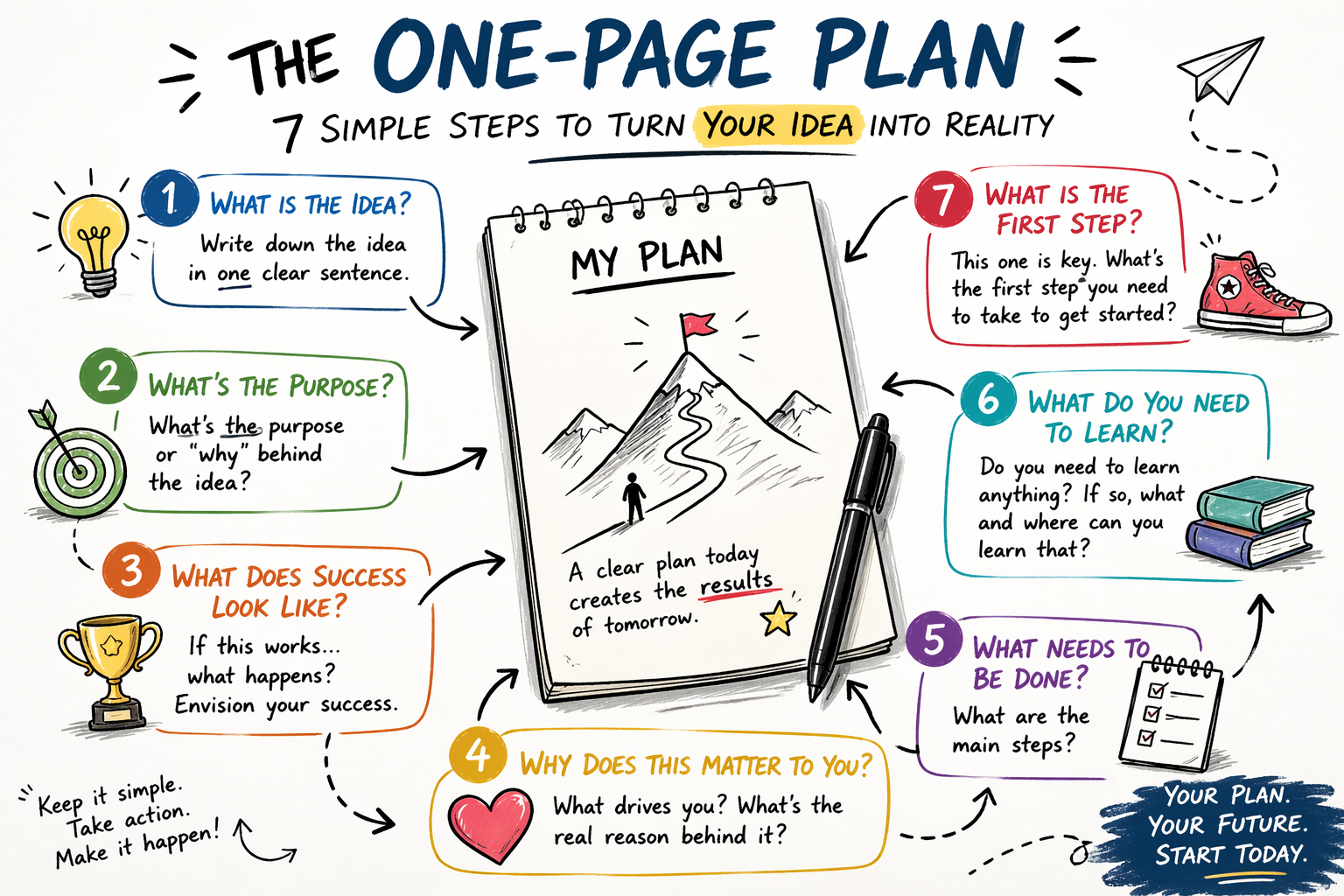
If you’re wondering how to actually do this, it’s simpler than you think. A one-page plan is built by answering a few key questions, and each one plays an important role in turning your idea into something real.
1. The Idea
Start by clearly defining what you want to do. Not something vague, not something broad, but something specific. The clearer the idea, the easier it becomes to act on it. This is the foundation of everything that follows.
2. The Purpose
Why does this idea exist? What problem does it solve? What is the purpose behind it? When you understand the purpose, your decisions become more focused and intentional.
3. The Outcome
What does success look like? If this works, what actually happens? Visualizing the outcome helps you stay aligned and gives your actions direction. This is a critical part of any goal-setting strategy.
4. The Why
Why does this matter to you personally? This is different from the purpose. This is your internal reason. The thing that keeps you going when things get difficult. Without this, it’s easy to lose momentum.
5. The Actions
What needs to be done? Not every detail, but the main steps. This is where you begin to turn ideas into action. Think in terms of phases: starting, building, launching, and improving.
6. The Skills
What do you need to learn? Where are the gaps? Most people stop because they don’t know how to do something, but that’s something you can solve. Identify the skills and decide how you’ll learn them.
7. The First Step
This is the most important part. What is the very first action you can take? Not the big picture, not the full plan, just the next step. This removes overwhelm and gets you moving.
Now, of course, once you get started, take action, and get moving, more planning will be needed but here’s why one-page plans work:
The power of a one-page plan lies in its ability to simplify everything.
Instead of trying to figure everything out at once, it gives you just enough clarity to begin. It organizes your thinking, sharpens your direction, and makes your next move obvious.
And once you take that first step, something changes.
You gain feedback.
You learn.
You adjust.
And slowly, that gap between thinking and doing starts to close.
So… remember, you don’t need a perfect plan.
You don’t need to know every step.
You don’t need to wait until everything makes sense.
What you need is a starting point.
So if there’s something you’ve been thinking about… something you’ve been putting off…
Take a few minutes.
Write it down.
Create your one-page plan.
And then take that first step.
Because everything you build…
Starts there!
Love,
Take your first step toward a life that actually feels yours.
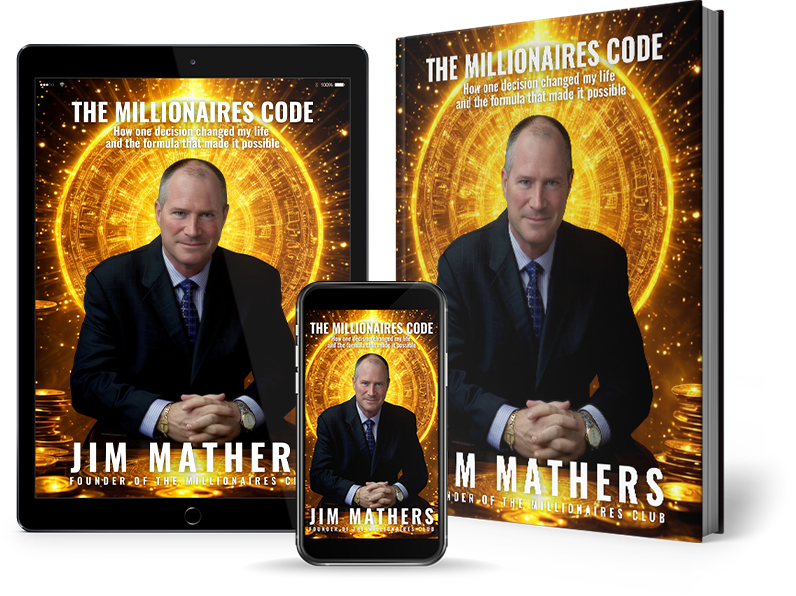
Download my free book, Cracking the Millionaire’s Code, where I share how I climbed out of rock bottom and built a life of financial freedom—one where I could finally pursue my purpose and achieve my goals.
Inside, you’ll learn the first step I took that changed everything, and a simple yet powerful formula I developed to help you take that first step.